Winchester family attic room
The HousemaidThe Winchester family attic room is a concealed upstairs space that Andrew Winchester presents as storage but uses to confine and control the women in his household. Its cot, dresser, mini-fridge, closet, and tiny window make it look like a modest room rather than a cell; its locked door, isolation from the rest of the house, and hidden camera reveal its punitive purpose. For Nina Winchester, repeated stays there become part of a long system of coercion. For Millie Calloway, discovering the room turns an ordinary search for papers into imprisonment.
Layout and First Discovery
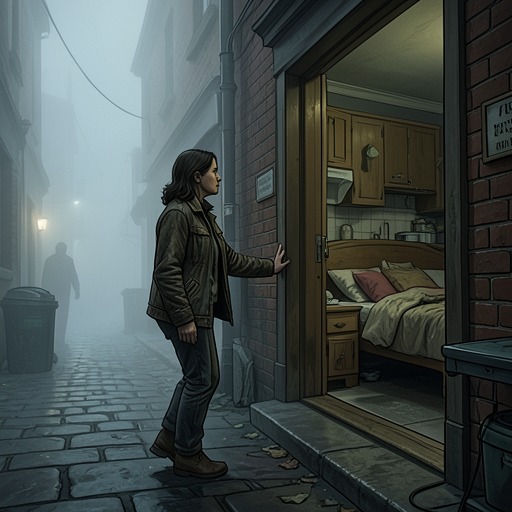
The room sits at the end of a small hallway reached by a dark, creaking staircase. Millie Calloway has lived in the house for about four months when Andrew Winchester asks her to help find work papers in the upstairs storage area. She has climbed the stairs once before, while Cecelia Winchester was napping, but found the door locked and turned back. Andrew describes the space as containing papers, so Millie follows him expecting a storage closet rather than a room.
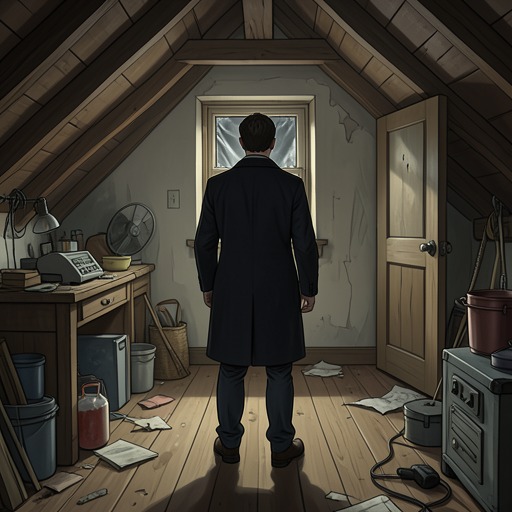
Andrew uses a small key to open the door and pulls a cord to switch on the light. Inside, Millie sees a cot pushed into one corner, a little dresser, a mini-fridge, and a single tiny window at the far end. Andrew points out a closet near the bed, saying that he keeps his stored belongings there. The furnishings lend the room the appearance of a usable living space, but the locked entrance and its separation from the occupied parts of the house make that appearance uneasy from the outset.
That unease becomes immediate when Andrew leaves and shuts the door behind Millie. She tries the doorknob, then throws her weight against it, but it will not turn. The room’s first revealed function is not storage: it is a place from which the person inside cannot leave at will. The staircase and locked door, initially just unsettling features of the house, become the threshold and mechanism of confinement.
Isolation, Darkness, and Surveillance
Andrew explains the room’s isolation by telling Millie that everything below the attic is soundproofed. Even a dinner party downstairs, he says, would not be able to hear her screaming. At midnight, three hours after she has been locked inside, Millie has pounded on the door and scraped at the wood until splinters are under her fingernails, and screamed until she loses her voice. She eventually gives up trying to attract the neighbors. The room’s position above the house is therefore not merely architectural: it prevents her distress from reaching anyone who might help.
The window and lighting are also made part of Andrew’s control. When Nina Winchester enters the room with him on a later occasion, he tells her to turn out the light. She pulls the cord and is briefly relieved by the darkness, only to realize that she cannot see. Andrew says that he has boarded up the window and installed new lights during the preceding week. With the light off, the room is pitch black; with it on, the bulbs are intensely bright. He frames access to light as a privilege and uses Nina’s failure to switch lights off elsewhere in the house as a justification for punishment. The change from a tiny window to a boarded opening and harsh artificial light makes the room’s atmosphere something Andrew can regulate.
The room also becomes a place of surveillance. After Millie challenges Andrew about how he can know whether she is lying, he tells her he can see her. She searches the walls for a camera, but cannot find it. Andrew says it is well hidden and that he has been watching her only since a few weeks earlier, not throughout her entire stay. The hidden camera extends his control beyond the locked door: even when alone in the room, Millie is being watched without knowing where the device is.
Nina’s Repeated Confinement
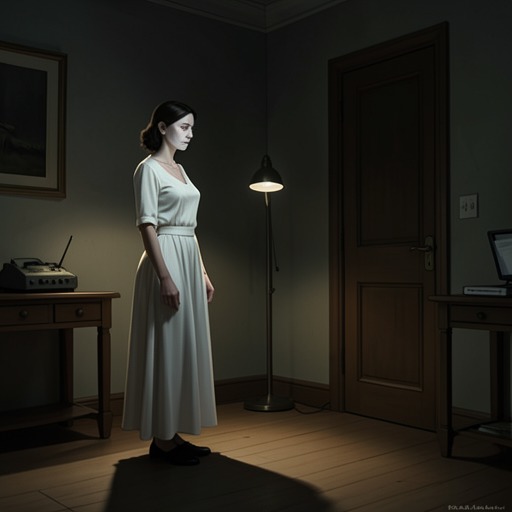
For Nina, the attic is not a single frightening discovery but a recurring condition of her marriage. After seven years with Andrew, she has tried bargaining for a way out, offering to leave with only Cecelia and the clothes she is wearing. She has also attempted to behave as a perfect wife, cooking elaborate dinners, keeping the house clean, and concealing her revulsion during sex, in the hope that Andrew would have less reason to send her upstairs. Neither compliance nor appeal stops the punishments. She eventually changes tactics, snapping at him and trying to repel him through her behavior and appearance; Andrew appears not to be deterred. When he catches her eating chocolate cake, he takes her to the attic and starves her for two days.
The timing and cause of Nina’s stays remain unpredictable. On average, Andrew sends her to the attic about once every other month, sometimes more often and sometimes less; once, six months pass without a stay. Nina does not know whether a given night will be spent in her own bed or on the uncomfortable cot, or what alleged transgression Andrew will punish. That uncertainty makes the room part of a continuing system rather than a response to any consistent rule. Nina also tries to find Kathleen Connors, Andrew’s former fiancée, hoping that someone who might support her account could help her approach the police. She cannot identify or locate her, and the room remains part of the control she has not found a way to escape.
Andrew’s leverage reaches beyond Nina herself. If Cecelia does something he considers unacceptable, Nina is punished. He buys Cecelia itchy, frilly dresses that she dislikes and that other children mock; she knows that refusing to wear them or getting them dirty may cause her mother to disappear for days. Nina fears Andrew may eventually punish Cecelia directly, but accepts her own confinement if it keeps her daughter safe. He also threatens Cecelia’s safety if Nina tries to leave, invoking an earlier near-drowning, and repeatedly puts peanut butter in the pantry despite Cecelia’s allergy. Nina throws it away, only for it to reappear; Andrew sometimes puts a little in Cecelia’s dinner, producing welts and showing Nina that even the threat of harm can reach from the household into the attic’s system of punishment.
Confinement as a Household System
Nina’s stays are reinforced by threats that extend beyond the room. She fears that if she resists, Andrew may send her back to the Clearview inpatient facility or arrange for Cecelia to be away for a week, as has happened before under the explanation that she is out of town. Nina believes her mental-health history would also make it easy for Andrew to portray her to the police as a danger who had kidnapped Cecelia. Her attempts to escape are therefore constrained by the prospect of losing access to her daughter as well as by the locked door.
During one confinement, Nina has been in the attic for about twenty hours after Andrew marched her upstairs once Cecelia had gone to bed. She does not argue, fearing the consequences. She has secretly obtained an IUD at a city clinic, using a false name and paying cash, because Andrew wants another child and she fears he would use that child to control her. The room’s recurring presence is connected to a broader struggle over her ability to leave and to protect Cecelia. When Enzo pounds on the attic door and calls Nina’s name, she says she is fine; he answers that she should open the door and show him. Even this exchange leaves the room’s basic condition intact: from inside, Nina must decide what it is safe to reveal to someone outside.
Meaning and Narrative Role
The room’s power comes from the contrast between its domestic scale and its carceral use. A cot, dresser, mini-fridge, and closet suggest a place made for ordinary living, while the locked door, soundproofing, boarded window, and camera turn those familiar features into parts of an enclosure. Nina even describes the storage space as a dungeon she had somehow made in her mind, a phrase that sets her own fear against the room’s concrete, coercive function. The physical room is small; the control exercised through it reaches into her marriage, her access to Cecelia, and her choices about leaving.
For Millie, the locked door makes the concealed purpose of the attic legible through action: the doorknob will not turn, her cries cannot be heard downstairs, and Andrew can watch her unseen. For Nina, its repeated use shows how confinement becomes one component of a patterned regime involving uncertainty, deprivation, surveillance, and threats against her daughter. The Winchester family attic room is thus both a setting for individual captivity and the architectural expression of Andrew’s power over the household.